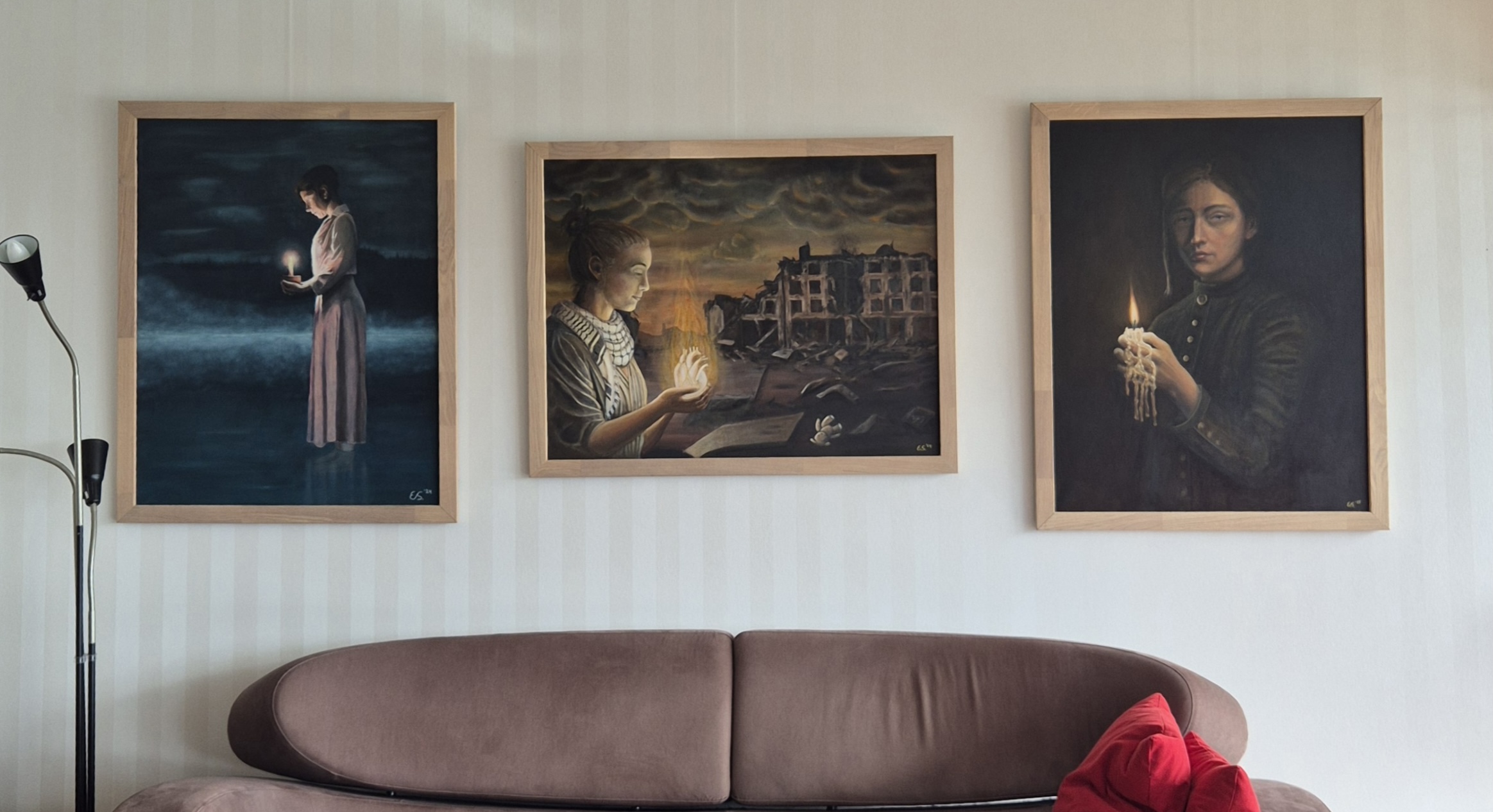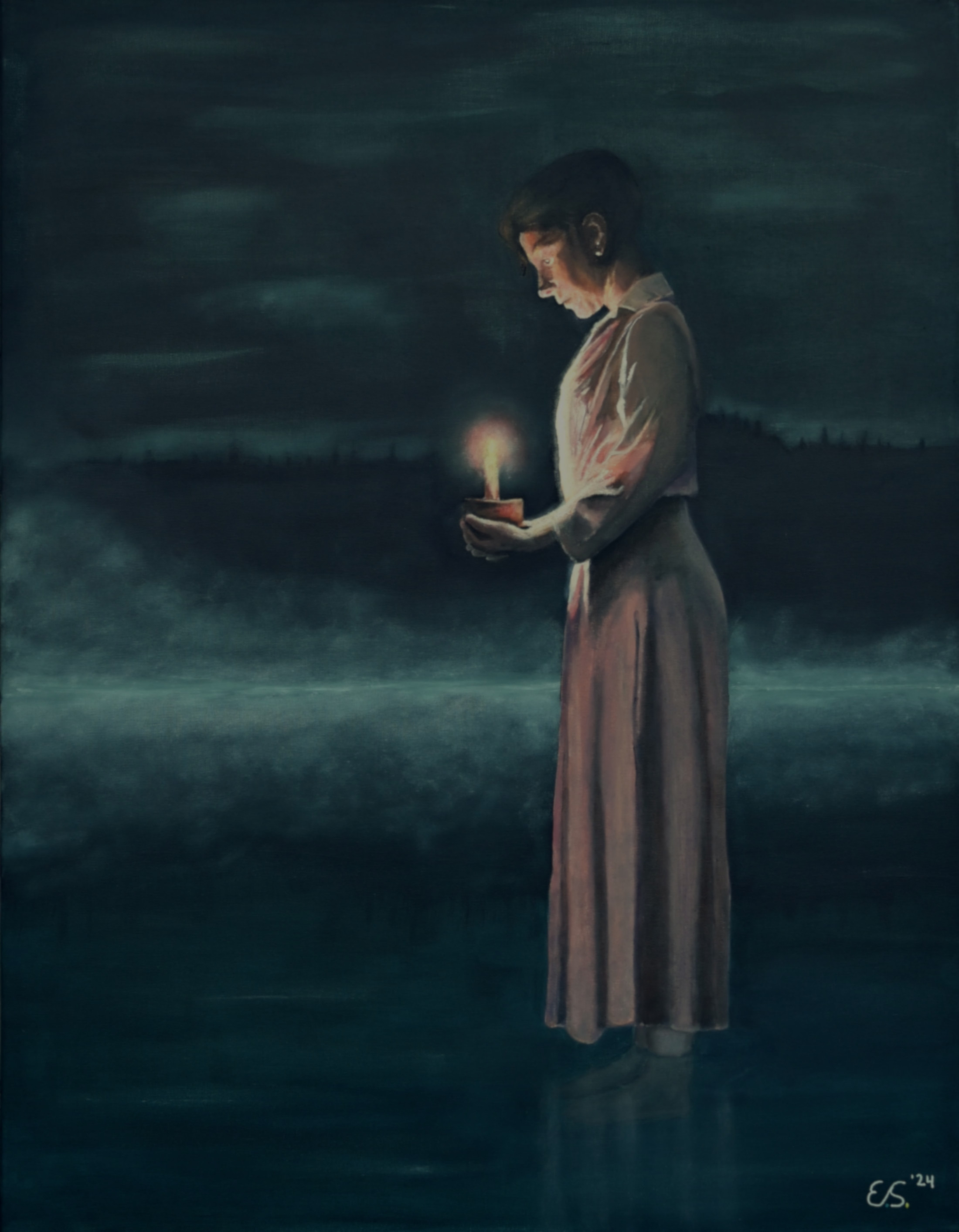
Elena
The series began with a photograph. Elena S. lives in Kovel, Ukraine. We know each other through Instagram — one of those connections that crosses borders without passports. When I saw her photograph in the early days of the war, standing alone in darkness holding a small flame, I understood that I needed to paint it.
Not because of its compositional qualities, though these are considerable. Because of what she was doing: holding light in a country where darkness had become the daily condition of existence.
Elena did not know she would become the first Lightbringer. She was simply standing in dark water, holding what she had. The series began there — in that specific, unplanned act of holding.
"There is a crack in everything,
that's how the light gets in."
Cohen's line is the series' first position: hope that arrives through damage. The crack is not a flaw. It is the condition of the light's entry. Elena's flame is small. The water around her is dark and cold. But the flame exists. In 2024, in Kovel, that was enough to be worth painting.
Selected for The Almenara Art Prize international online exhibition, 2025. Chosen as Art of the Month, October 2025, by Kreatima.com.
Cecilia
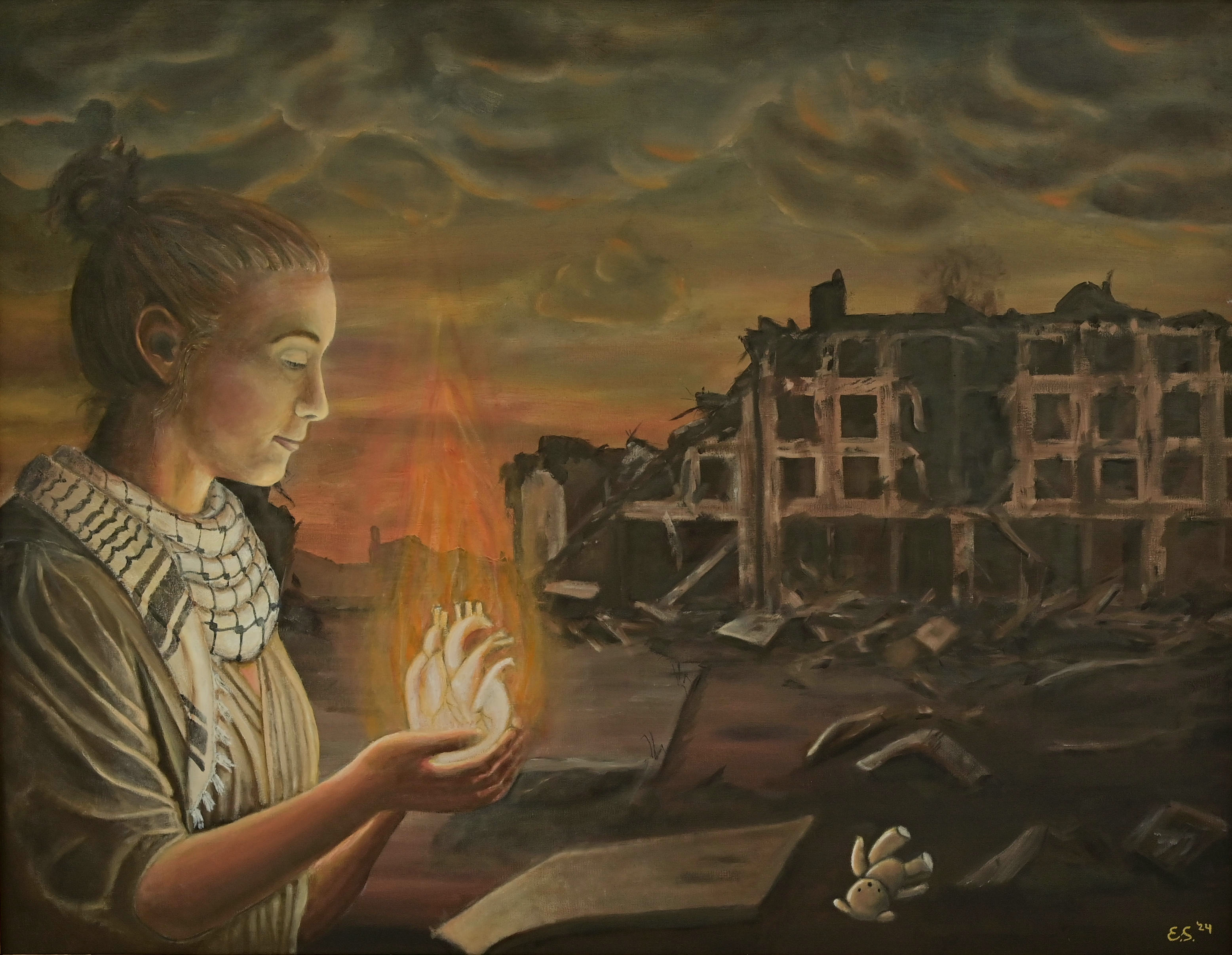
Cecilia is a young Norwegian woman who spent her early twenties living among both Israeli and Palestinian communities. She knows that land and its people from the inside — specific streets, specific faces, specific places that are now rubble or graves.
She watches the current destruction from a distance, carrying a love that has nowhere to go and a fury that cannot be spent. She holds her burning heart — not a symbol of romantic love but of love that cannot be extinguished and cannot reach what it most needs to reach.
Behind her, a city has been destroyed. A child's toy lies in the rubble. She wears a keffiyeh. The subtitle is her statement and her condition: offering a dark world my burning heart.
"Do not go gentle into that good night,
Rage, rage against the dying of the light."
Thomas's line is the series' second position: furious resistance to extinction. Where Elena holds a small flame with quiet endurance, Cecilia burns from the inside — the light is no longer held but generated, at enormous personal cost. The fire is hers. It is also consuming her.
Selected for The Almenara Art Prize international online exhibition, 2025.
Dolores
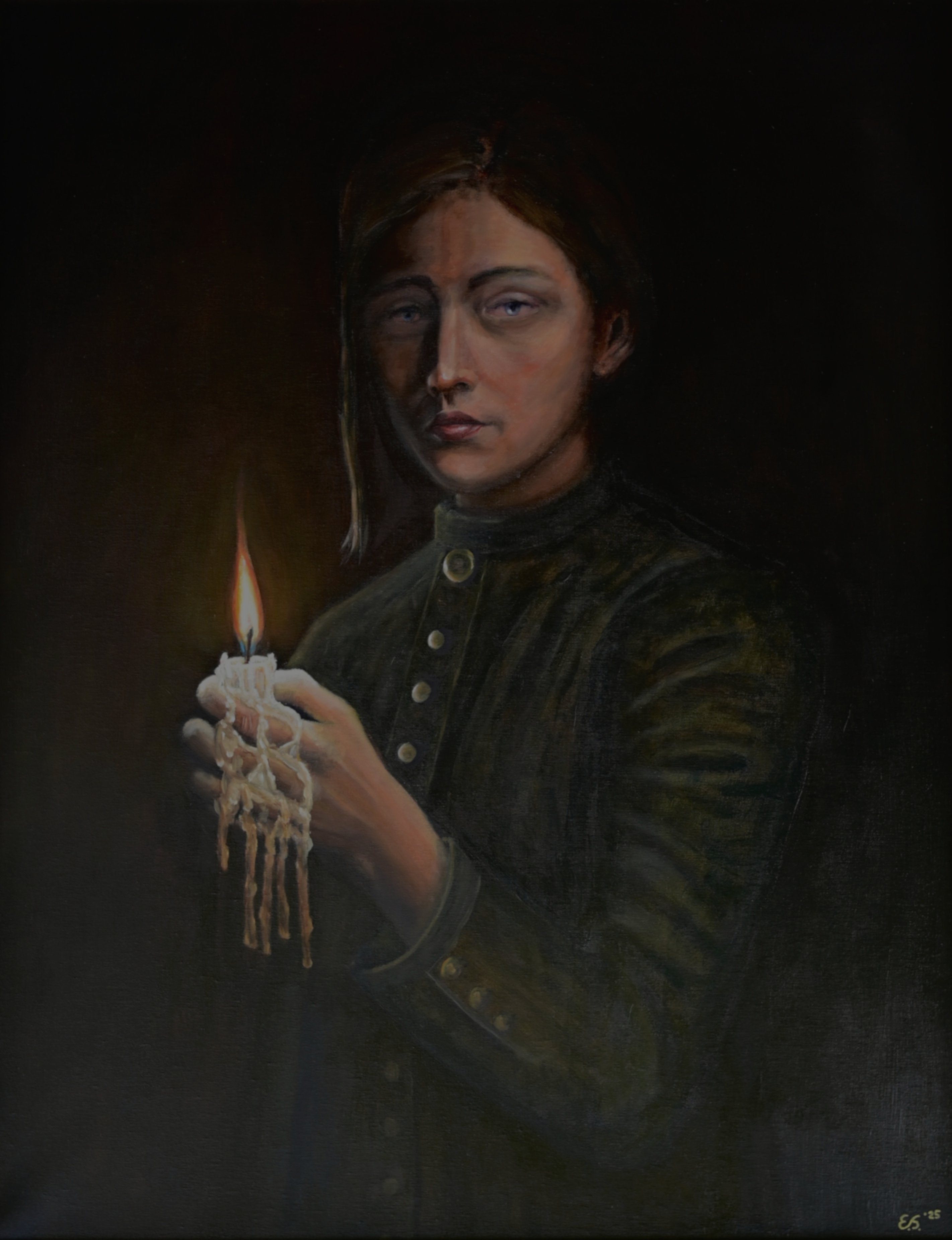
Her name means sorrow. Her candle is nearly spent — wax dripping, flame faint and fragile, the darkness patient and enormous around her. She has carried this light for a long time. She is the last. After her there is no one left to carry the flame.
Dolores completes the series. She does not complete it hopefully. She completes it honestly — as the end of a sequence that began with Elena's quiet endurance and Cecilia's burning fury, and arrives here: at the edge of extinction, with what remains of the light.
"Darkness had no need
of aid from them —
She was the Universe."
Byron wrote Darkness in 1816 — the year without a summer, when volcanic ash blocked the sun and people genuinely believed the world might be ending. The poem does not offer consolation. Darkness does not need help. It is patient. It wins.
The series is finished. A fourth Lightbringer is not possible after Byron's conclusion. There is no one to come after Dolores. This is where the argument ends — not with resolution, but with the truth of where the light goes.
Jury Prize, Vår egen høstutstilling, Steinkjer Kunstforening, 2025.